2025 · December
ASH 2025: AI Model Enhances Risk Prediction for Vascular Events and Disease Progression in MPN
Ground Truth Labs
Team
At ASH 2025, we presented MEAM—a multi-endpoint AI morphology model that predicts vascular events, fibrotic transformation, blast phase disease, and death in patients with essential thrombocythemia (ET) and polycythemia vera (PV). Trained on nearly 1000 patients across international cohorts, MEAM identifies high-risk patients that conventional scoring systems miss—particularly younger patients under 60.
The challenge with current risk models
Myeloproliferative neoplasms are clinically heterogeneous. Identifying which patients will experience life-altering vascular events or progress to myelofibrosis or blast phase disease remains difficult. Conventional risk scores like IPSET and R-IPSET-T rely on a limited set of clinical variables—and age dominates these models. Younger patients often fall into low-risk categories regardless of their underlying disease biology.
What we built
Working with collaborators across Oxford, MD Anderson, Cambridge, Guy's & St Thomas', and other international centers, we trained a vision transformer on 1661 H&E bone marrow images from 949 patients. The model simultaneously predicts risk across four endpoints: vascular events, MF transformation, AML/blast phase transformation, and overall survival.
The model achieved strong validation performance, with C-indices of 0.9 for MF transformation, 0.85 for AML transformation, 0.75 for death, and 0.6 for vascular events.
What we found
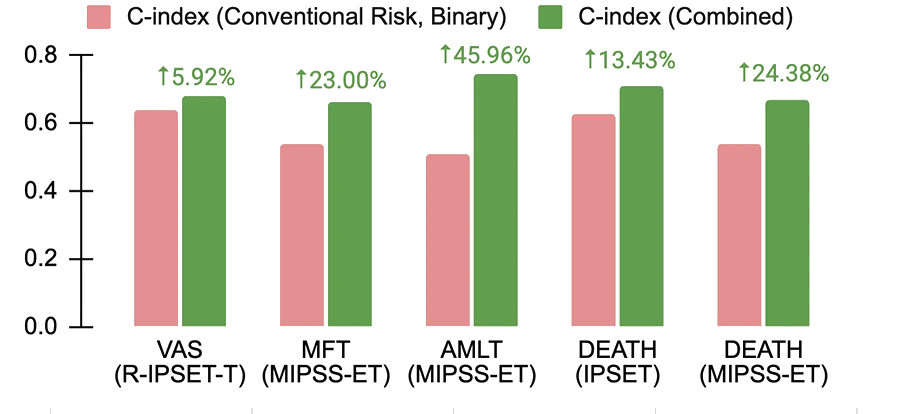
MEAM improves on conventional risk scores. When combined with existing models like R-IPSET-T and MIPSS-ET, MEAM improved prediction across all endpoints in both ET and PV patients. In ET patients, the improvement ranged from 6% for vascular events to 46% for AML transformation prediction.
Younger high-risk patients are being missed by conventional models. Of 35 patients under 60 who experienced a vascular event, R-IPSET-T classified 77% as low or intermediate risk. MEAM correctly flagged 37% of these as high risk. Among 34 deaths in this younger group, conventional models labelled every patient as low or intermediate risk. MEAM identified 38% as high risk.
MEAM detects treatment effects. Patients in the PT-1 trial treated with anagrelide showed a greater increase in MF transformation risk scores compared to those on hydroxyurea—consistent with the original trial findings. This suggests MEAM can track therapy-driven disease modification.
Why this matters
Current risk models struggle with younger patients because age carries so much weight. MEAM extracts risk signals directly from bone marrow morphology, capturing disease features that clinical variables miss. This opens the door to more personalized risk assessment—and to measuring whether new therapies actually modify disease course.
We're continuing to validate MEAM across additional cohorts and working toward integration into clinical workflows.